
Our Lady of the Rosary
The Parish Church of Our Lady of the Rosary
The parish church of Sant'Agabio now overlooks Piazza Monsignor Brustia.
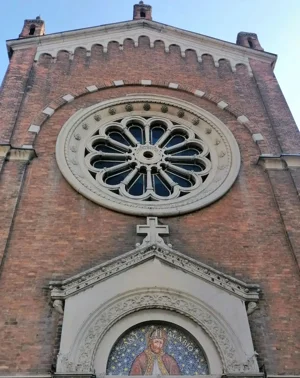
It is built in the Neo-Romanesque style, with three naves, featuring oblong windows along the side aisles and round windows on the façade.

History and architecture
A building that has evolved over time
The church’s structure results from the integration of the 18th-century section — the bell tower, choir and chancel — with the newer part. The brick façade, with ornate inserts in artificial stone, is 20 metres high and is divided into three sections, corresponding to the naves.



Light and symbols
The rose window and stained-glass windows
During the restoration work on the parish church carried out in 1975–76 by the Beato Angelico School in Milan, directed by Monsignor Vigorelli, the artistic stained-glass windows were created by the Grassi firm of Milan. Their meaning is based on a specific theological concept.
The central rose window, situated above the main entrance, features the symbol of the Trinity at its centre and is intended to represent God at the moment of creation.
The eight circular stained-glass windows, situated in the upper section, were specifically designed to illustrate the theme of creation, as presented in the Book of Genesis.


The seven stained-glass windows in the side aisles, with their simple, linear design, offer a evocative symbolic interpretation of the sacraments. With their varied colour tones, they lend the church an atmosphere of deep contemplation.
In the left-hand aisle, we find depictions of Baptism, the Eucharist, the Anointing of the Sick and Marriage. In the right-hand aisle, on the other hand, Confirmation, Penance and Holy Orders are depicted.


Art and Devotion
The High Altar and the chapels
The Baroque-style high altar, situated at the centre of the chapel and set apart from the wall, is undoubtedly the finest piece of architecture in the church. It was moved from the old parish church near the ramparts and probably dates from between 1706 and 1709.
The choir is situated in the circular apse, with wooden stalls arranged in two rows. At the ends of the side aisles are the chapels dedicated to the Blessed Virgin of the Rosary, patron saint of the parish, and to the Crucifix.


Blessed Virgin of the Rosary
The Altar of Our Lady
The Altar of Our Lady, designed by the Franciscan friar Giovanni Maria Tognazzi, originally from Sant'Agabio and completed in 1962, is made of white marble and features three niches with statues at the top.
The Our Lady of the Rosary, in the centre, is the work of Sella (1824–1902), a pupil of Terrioli in Varallo and, for many years, a teacher of woodcarving and sculpture at the Bellini Institute in Novara; the statues of Saint Anthony and Saint Joseph on either side are made of wood and come from Val Gardena.

St Francis and the Crucifix
The Chapel of the Crucifix
The north altar found its permanent home with the installation of the sculptural group produced in Ortisei in Val Gardena, depicting St Francis embracing the Crucifix, donated by the Franciscan Tertiaries in 1926 to mark the seventh centenary of the saint’s death.

The wooden Crucifix
The 1964 Crucifix
At the centre of the altar stands a large wooden crucifix, the work of Professor Fornara of Borgomanero. This work of art was commissioned in 1964 to commemorate the twenty-fifth anniversary of the priesthood of the parish priest, Monsignor Eugenio Lupo.

Historical record
The design of the crucifix
The photomontage documents the installation of the Crucifix in the parish church of Sant'Agabio to mark the 25th anniversary of Monsignor Eugenio Lupo’s priesthood.
Sant'Agabio
The painting in the Chapel of Our Lady of the Rosary
In the Chapel of Our Lady of the Rosary there is a painting, by an anonymous artist, depicting sant'Agabio dressed in the vestments for the celebration of the Eucharist.
At the feet of the holy bishop stand two angels; one holds a chalice containing the Eucharistic host, whilst the other holds a thurible. The shape of the frame suggests that it may have been an altarpiece, but it is not possible to determine from which church or altar it originated.


Art and Memory
The frescoes depicting the life of Sant'Agabio
In the central nave and on the back wall are seven frescoes by Mazzucchi, painted in 1946–47.


Historical documents
The construction and consecration
Two records preserve the memory of the church’s history and its key figures.


The relic of Sant'Agabio
The saint’s right arm and hand
Among the relics preserved in the parish church of Sant'Agabio, the most interesting item is undoubtedly the reliquary containing the right arm and hand of sant'Agabio, which is displayed on the feast day on 10 September.
The separation of this relic from the rest of the saint’s body – which was transferred to the cathedral at the behest of Bishop Cadulto around 890 – is thought to date from that same year, though there are no documents of any kind to corroborate this claim.
The arm, housed in a separate reliquary, remained in the parish church of Sant'Agabio until 1553, when, by order of Bishop Cardinal Morone, it was transferred to the cathedral.
In an inventory of the parish church’s furnishings compiled by the parish priest Andrea Tettoni in the same year, the reliquary is described as being in the shape of a gilded copper arm, with a silver hand.
In 1740, the Merchants’ Guild donated the present reliquary.
On 2 January 1637, the mayors and councillors of the merchants’ guild had in fact resolved to choose sant'Agabio as their patron saint. They would celebrate the feast day on 10 September in the chapel dedicated to the saint in the cathedral, and on that day the shops would remain closed; they would display the saint’s banner and make an offering of wax to the chaplain and the canons.
Plans were also in place to commission a painting depicting the saint, to be kept in the council chamber. By a decree dated 15 July 1637, Philip III approved this decision, and on 8 September, the Vicar General of the Diocese, Niccolò Leonardi, approved the petition submitted by the mayors of the University, Nicola Pellizzari and Bernardino Legnano.
An inventory from 1779 states that in that year the reliquary was kept in the cathedral’s sacristy, together with other relics of the saint: “A silver arm, entirely inlaid with gilded ornamentation, featuring two crystals and a gold ring set with a yellow topaz, in which is preserved the miraculous arm of our patron saint Sant'Agabio; this reliquary was donated by the University of Commerce of this city in the year 1740. The whole is fitted with seals, with a wooden case covered in leather”.
Throughout the nineteenth century, the reliquary was one of the most venerated; in times of need or danger, it was displayed or carried in procession. The last inspection of the relic took place in 1879. The coat of arms of Monsignor Stanislao Eula is still discernible on the seal affixed to the base of the reliquary. Since 1927, the relic has been returned to the parish church.
On 29 September 1926, the church council of Sant'Agabio had sent a petition to the bishop seeking the return of the patron saint’s body.
The bishop had consulted the cathedral chapter, which, at its meeting on 14 January 1927, had expressed an opinion against the handover of the body but in favour of the return of the distinguished reliquary containing the arm.
On 20 January, the chapter sent a letter to the bishop setting out the canons’ opinion, and on the same day Monsignor Castelli forwarded it to the parish priest.
On 29 April, with great solemnity, the bishop, accompanied by the cathedral’s penitentiary, Father Pietro Coffano, and the rector of the seminary, Father Carlo Stoppa, handed over the reliquary to Father Bairate.
